Highlights from Citeline survey of physicians shared at PHUSE US Connect
Article
薬事規制関連支援サービス

One goal of the Citeline survey was to understand what is causing the gap between what physicians talk to their patients about clinical trials and what patients want to hear.
Clinical trial recruitment challenges are often discussed in terms of timelines and budgets. But behind those metrics are real patients and physicians navigating an increasingly complex discovery process.
That challenge became personal through the experience of a physician whose husband had advanced cancer. After standard treatments had failed, participation in a clinical trial became his only remaining option.
The physician, referred to here as Dr. B., was better equipped than most to search for a relevant clinical trial. She had medical training, access to a professional network, and the ability to interpret the clinical literature herself. Even so, her experience illustrates how difficult it can be to identify an appropriate clinical trial.
Shared by Francine Lane, Citeline Head of Transparency, at the recent PHUSE US Connect conference, Dr. B.’s experience provided context for a broader examination of challenges in how physicians search for and evaluate clinical trials when considering patient referrals.
Building on that experience, Lane presented findings from a Citeline survey examining how physicians search for and evaluate clinical trials. “We kept seeing her [the physician’s] experience reflected in the data,” Lane said, noting that many of the challenges Dr. B. encountered were not isolated to a single case.
While enrollment delays are often discussed in financial terms, Lane emphasized that the impact is human. “Enrollment delays are expensive. We all know that this is not a surprise to anyone,” she said. “But Dr. B.'s experience means that it's not just about the numbers. It's also a personal story that sits inside a much larger problem.” Lane noted that 80% of trials miss their enrollment targets, resulting in costly delays. “Every day that the trial runs behind is a day that someone is waiting,” Lane said.
According to the 2025 Perceptions & Insights Study from the Center for Information and Study on Clinical Research (CISCRP), 51% of patients surveyed say their preferred way to learn about a clinical trial is through their doctor, yet only 17% of patients report that this actually occurs. “There's a gap there between what physicians talk to their patients about and what patients want,” Lane said.
Lane explained that while significant investment has been made to address trial recruitment challenges, including technology platforms, AI-matching tools, and patient-facing resources, relatively little research has focused on the physician perspective in trial discovery. “So, we decided to ask the physicians ourselves,” she said.
To better understand how physicians experience clinical trial search and evaluation in practice, Citeline conducted a survey of 144 practicing physicians across 16 specialties between October and December 2025 via the Skipta platform. The survey explored four questions:
A majority of the physicians responding to the survey, 63%, reported searching for clinical trials in the past year. Among those who searched, ClinicalTrials.gov was the most commonly used source with 86% reporting that they use it. However, 25% said they would strongly recommend it as a source.
Searching for trials did not necessarily translate into successful referrals. Even among physicians who did search for clinical trials, Lane said 53% of them rarely or never referred a patient. The other 47% were able to refer at least half the time.
Lane connected these findings back to Dr. B.’s experience, noting she initially relied on her professional colleagues to identify potential trials. Ten colleagues provided her with lists of studies for her to consider, yet not a single trial was common across the lists.
Information quality emerged as a central barrier. In the Citeline survey, 69% of respondents said information challenges prevented them from referring a patient to a trial. “And this is exactly the problem that our physician found herself in,” Lane said. The available information was not sufficient to confidently narrow options and select an appropriate trial.
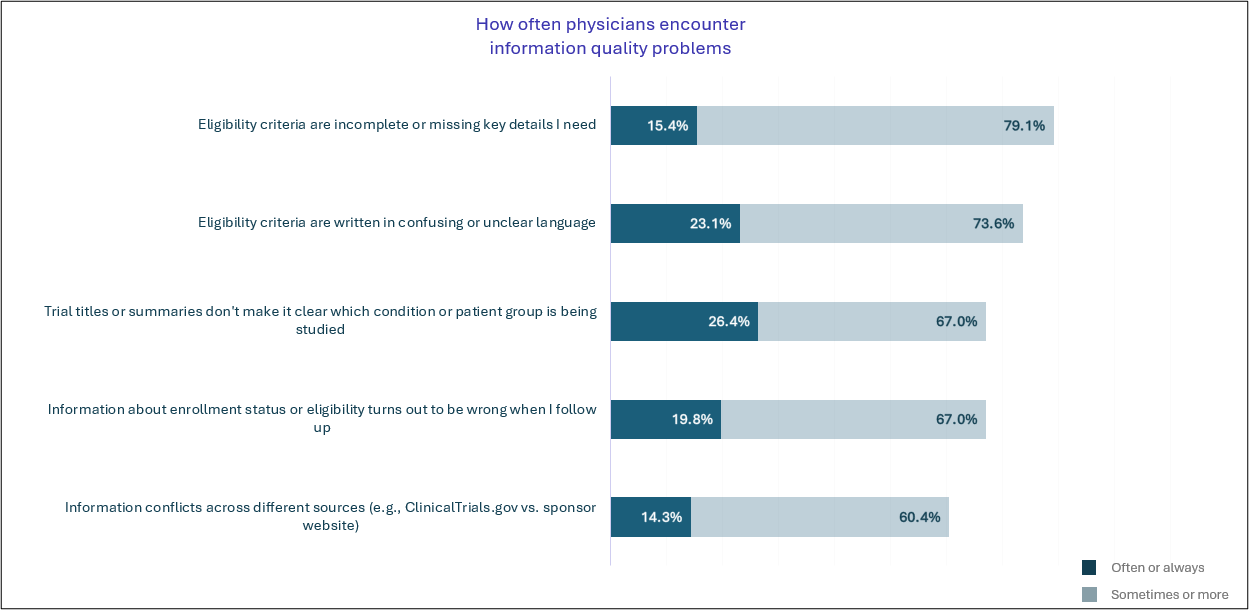
Specific information gaps were widespread. Nearly 80% of respondents reported that eligibility criteria were incomplete or missing key details, while more than 70% said eligibility criteria were written in confusing or unclear language. In addition, about two-thirds of trial titles or summaries did not clearly identify the patient population being studied.
As her search expanded beyond her professional network, Dr. B. began querying ClinicalTrials.gov. Using the broadest relevant term, “head and neck squamous cell carcinoma” returned nearly 2,500 studies. The phrase “cancer of the head and neck” returned 6,895 results. “She kept searching,” Lane said, “with different search terms returning very different numbers of studies. She is well informed and knows the different condition names to search for, but many non-medical or non-healthcare professionals would struggle to know where to start.” Ultimately, Dr. B. found one trial that looked especially promising for her husband, but it was listed under “all solid tumors.” There was no mention of head and neck cancer, illustrating how relevant trials can be difficult to identify, even when they exist.
When physicians were asked what information they prioritize in evaluating a clinical trial, their top response aligned closely with these challenges. Detailed eligibility criteria ranked as the most important factor, followed by a clear description of the condition being treated, the study location, and prior treatment requirements.
“This is where you come in,” Lane said to the clinical trial disclosure professionals. “There are things you can do as disclosure experts that can help alleviate the recruitment problem.”
The first is to provide informative titles. Including the condition and patient population in the title and in the brief summary can significantly improve search and filtering outcomes.
The second is to give clear eligibility requirements. “Present criteria early and clearly,” Lane advised, noting that key requirements that are buried or vaguely described can require extra effort to understand and refer.
The third is precise condition terminology. Lane encouraged using clinical terms as the primary description of the condition with plain language equivalents when appropriate, but not to rely on it exclusively. “That doesn't help physicians who need the specific disease they're searching for,” she explained.
In addition, trial information, in particular eligibility criteria and trial status, needs to stay updated and current across study sites and the search platforms. Lane noted that while regulations require updates within 30 days of a change, recruiting trials may need more frequent updates to reduce friction when trying to refer.
Finally, sponsors should provide actionable referral pathways, such as a central contact point, so physicians can confirm trial eligibility and availability without contacting individual sites. “Even the best search tools, including AI,” Lane warned, “cannot fix incomplete or ambiguous trial data.”
Disclosure professionals have the power to influence whether a physician’s search leads to a meaningful referral or reaches a dead end, Lane concluded. Through clear, accurate, and actionable trial information, disclosure teams shape how readily physicians can identify appropriate options for their patients.
“Our data show that physicians are searching. They want to refer patients. Patients want to be referred,” Lane said. Returning to Dr. B.’s experience, she ultimately found and enrolled her husband in a trial that gave him five additional months of life.

Don’t let the April 28 enforcement catch you off guard. Gain critical insights and practical guidance to achieve compliance with new UK clinical trial transparency rules for trial registration and results publication.