BIO 2026: AI, Innovation, Collaboration, and Other Perceptions from a First-time Attendee
Article
Clinical

Several themes surfaced during the four-day BIO 2026 conference, including artificial intelligence, collaboration, and innovation. Recurring topics included US-China competition and the US launch of Operation Trialblazer to accelerate drug development.
As we were walking through the exhibit hall at the BIO International Convention, a colleague and I commented that it reminded us of Disney’s EPCOT. Signage welcomed us to country pavilions ranging from Abu Dhabi to Wales. The global reach of the pharmaceutical industry was perfectly reflected in the massive hall. This was my first time attending BIO, and to say it was overwhelming (a comment I heard from others throughout the four-day event) is an understatement. Here are a few recurring themes I encountered during the conference.
It should come as no surprise that artificial intelligence (AI) was top of mind. One panel, “Agentic AI in Clinical Trials: Accelerating Recruitment and Streamlining Operations for Large-Population Diseases,” dove into AI agents. Dianne Paraoan, Acting Director of the US Food & Drug Administration (FDA) Office of Medical Policy, Center for Drug Evaluation and Policy (CDER), was quick to point out that Ella, the agency’s agentic AI tool, “doesn’t make regulatory decisions for us.”
This and other sessions referenced the June 22 launch of Operation Trialblazer by the US Department of Health and Human Services (HHS) to accelerate clinical trials. The initiative includes National Institutes of Health (NIH) strengthened support for “advancing the responsible use of artificial intelligence.”
Paraoan made another distinction when it comes to AI. “It’s not just the human in the loop,” she said. “It’s the experts.
Because this discussion revolved around large-population diseases, Tran Le, General Manager, Life Sciences, for Hippocratic AI, said many AI agents are not applicable, for example, when recruiting for three patients for a rare disease trial. I couldn’t help but think that’s where solutions like Citeline PatientMatch come in.
AI took center stage in a discussion with Ashley Magargee, CEO of Genentech, and Kimberly Powell, VP of Healthcare at NVIDIA. Rounding out the trifecta of powerful women was moderator Katie Couric. In a new spin on the “human in the loop” caveat around AI and the “human in the lead” twist shared at the SCOPE summit, Magargee referred to “the lab in the loop.” She said organizations must use AI to take advantage of their “data flywheel.”
Couric underscored the ever-important role of data in AI. “People are saying that data is the new oil” feeding AI, she said.
In a panel session on building marketable AI platforms in biotech, the discussion kept pivoting to the topic of insuring clinical trials as panelist Tomas Philipson of MEDA Ventures explained and defended the concept.
Tristan Hunt, Partner at Averin Capital, voiced his support of AI in the life sciences. “Biotech and healthcare is probably the most durable, defensible” area for AI, he said.
In addition to our sister company Evaluate’s launch of its annual World Preview report at BIO, Daniel Chancellor, VP of Thought Leadership at Citeline’s parent company, Norstella, co-led the session, “The State of Emerging Biotechs: Investment, Deal, and Pipeline Trends.” He was joined by Chad Wessel, a Senior Director at BIO.
Here are a few key takeaways:
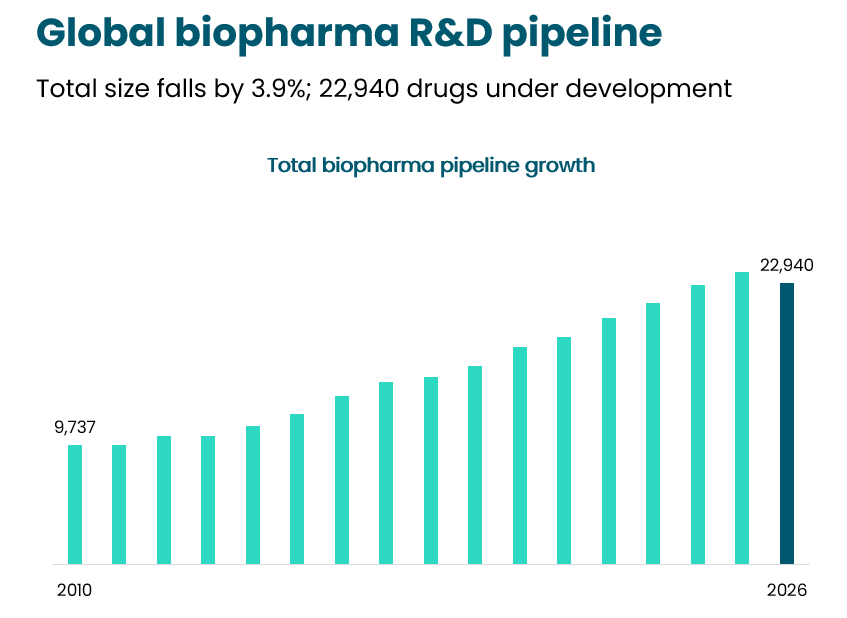
“Small companies are really the workhorse of the industry,” Chancellor said. He noted deals are moving away from transactional to being a transfer of assets, and that most of the companies actively acquiring are those approaching patent cliffs. “We certainly hope for the risk appetite to cycle,” he added.
Referring to recent rounds of layoffs at pharma companies, Wessel said, “It’s been a little bit of a roller coaster quarter by quarter.”
While many discussions circled back to the ongoing competition between the US and China, one session focused on Europe’s strengths, including smart regulation. When I think of the European Medicines Agency (EMA), regulatory requirements come to mind. But Falk Ehmann, Head of the EMA’s Innovation and Development Accelerator, explained how his agency provides support “from bench to bedside” for small to medium enterprises across the medicine lifecycle in the EU. The EMA holds Innovative Task Force (ITF) meetings to assist developers with innovative medicine programs. Ehmann said the EMA has proposed regulatory sandboxes that would allow the testing of an innovative development in a controlled environment for a limited period of time.
When asked how the EMA is working to keep companies in Europe, Ehmann said the agency is working with the FDA so that its standards are similar. “If you want to be a big player in the world,” he said, “you have to take a step toward harmonization, not away from it.”
BIO proved to be entertaining as well as informative. The conference theme, “Driven by Purpose” was inspired by INDY NXT race car driver James Roe, who has conquered asthma to become a high-performance athlete.
Keynote speakers included Marcus Freeman, head football coach at Notre Dame. He talked about leadership and the importance of culture. “Culture isn’t what you say. It’s what people feel.” He spoke of the school’s golden standard — challenge everything, unit strength, and competitive spirit — and I felt a surge of pride as I thought of Citeline’s own gold-standard data.
Actor/director Gary Sinise, known for his role as Lt. Dan in “Forrest Gump,” shared his passion to support veterans via the Gary Sinise Foundation. His band, the Lt. Dan Band, performs for US troops around the world. His connection to the world of pharmaceuticals is a personal one. His father suffered a stroke, his wife is a breast cancer survivor, and his son Mac, also a musician, succumbed to a rare bone cancer.
BIO CEO John Crowley, a Notre Dame alum and a veteran, introduced both speakers. He is no stranger to the impact disease can have on a family. Two of his children were diagnosed with Pompe disease, prompting him to co-found Novazyme Pharmaceuticals. His race to save his children was captured in the movie “Extraordinary Measures.”
Musician James Roe, a brain cancer survivor, gave an emotional performance. He was introduced by Mona Jhaveri, executive director of the Music Beats Cancer program. A guitarist and singer, the tumor robbed Roe of use of his right hand, but he eventually regained functionality.
Throughout the conference, partnerships dominated panel discussions — and I’m referring to working relationships, not the financial partnerships so eagerly sought after at BIO.
The panel “Beyond the Hype: How AI Is Actually Transforming Biopharma in 2026,” touched on this theme. Four AI-biopharma partnership archetypes were presented:
In terms of resource allocation, Aliza Apple, VP of Catalyze 360 AI, said companies must decide what AI tools they should build and what they should license.
Mary Rozenman, CBO/CFO of Insitro, echoed this, stating that companies must determine whether to build, buy or partner for AI tools. She acknowledged that pharma companies’ data includes vast amounts of information on patients and diseases. She noted that using the right AI tools will glean great insights. However, obstacles remain. “It’s still really hard for people to do a trust fall into their data,” she said.
In the Couric-moderated panel, NVIDIA’s Powell cautioned that the next generation of scientists must be poised for AI adoption. She said collaboration with academia and institutions such as the NIH and National Science Foundation (NSF) must ensure these professionals are trained in both disciplines: science and AI.
Regulatory issues were addressed in several sessions, including “‘Radical Transparency’ at FDA: What Has It Meant in Practice?” All panelists were authorities on the topic, having formerly worked at the agency. Moderator Joe Franklin, Chief Legal and Policy Officer of BIO, said the phrase “radical transparency” came to the forefront in July 2025 when the FDA published over 200 complete response letters (CRLs). A CRL is an official notice issued by the FDA indicating that a new drug or biologic application cannot be approved in its current form.
Ritu Nalubola, Director of Life Sciences & Healthcare at the Marwood Group, said transparency is contingent upon increased internal collaboration and coordination with HHS agencies such as the FDA and the Centers for Medicare & Medicaid Services (CMS).
In a session on AI platforms, Tyrone Lam, Chief Business Officer of GATC Health, reiterated the benefits of collaboration. AI, he said, calls for approaches that encompass both creativity and partnerships.
The partnership theme was front and center in the session titled “Patients: Our Innovation and Advocacy Partners.” Although the panelists were all based in Colorado, the issues they discussed were global in scope.
Partnerships are necessary to bridge the gap between funding and getting treatments to reach patients in time, said Sujatha Venkataraman, founder of Vināśa Oncology. She said partnerships should be fostered among clinicians, academic institutions, clinical teams, policy makers, and philanthropists.
Abby Bronson, VP, Patient Advocacy & External Innovation at Edgewise Therapeutics, said sponsors should not wait until Phase III for patient input. “They really should be partners from the beginning,” she advised.
Bigyan Bista, SVP, Capital Formation & Global Partnerships at Enveda, agreed, saying patient voices are not afterthoughts but a scientific imperative.
Amy Goodman, VP and Counsel for Policy + Advocacy at the Colorado BioScience Association, summed it all up: “The more we work together and collaborate, the more we can reach our goals … and the more effective we can be.”

Darcy Grabenstein
Director of Content Strategy and Thought Leadership | Citeline
Darcy is the Director of Content Strategy and Thought Leadership for Citeline. A journalist by training, she has more than 30 years of experience in marketing, advertising, and public relations.
What are key trends shaping the global biopharma pipeline?
The global drug pipeline has contracted for the first time in years. Small biotechs are driving 72% of all programs, with 60% of those having no development partner — a significant licensing opportunity. R&D costs have doubled in five years, M&A activity is on track to exceed $200 billion for the second consecutive year, and $500 billion in revenue is at risk from the patent cliff by 2032.
What are four archetypes of AI–biopharma partnerships?
In the session titled "Beyond the Hype: How AI Is Actually Transforming Biopharma in 2026" four models were outlined: infrastructure & enablement , capability augmentation, co-discovery/shared risk, and AI-native biopharma.
How is the FDA approaching "radical transparency" in drug approvals?
"Radical transparency" became a prominent phrase in July 2025 when the FDA published over 200 complete response letters (CRLs) — official notices indicating a drug or biologic application cannot be approved in its current form.