Looking Back at SCOPE Summit 2026: Recruitment Trends
Blog
Patient Engagement & Recruitment

Numerous patient recruitment challenges — and possible solutions — were discussed at SCOPE Summit 2026. A recurring theme was attributing these challenges to systemic problems.
So many sessions, so little time.
In addition to the ever-present buzz about artificial intelligence (AI), patient engagement and recruitment was a hot topic at SCOPE Summit 2026. The recruitment-focused program had two tracks, one on enrollment planning and patient recruitment, the other on diversity and retention, including the patient experience.
Because patient engagement, recruitment, enrollment, and diversity in clinical trials are areas I’m passionate about, I scurried from one session to another. Let’s just say I easily hit my goal of 10,000 steps each day of the summit.
After all, isn’t that what it’s all about, sponsors hitting their recruitment goals for trials?
A recurring theme at SCOPE, starting with the opening plenary session, was attributing recruitment challenges to system-wide problems, such as access to clinical trials. In one session on diversity in clinical trials, Tyler Allen, Program Leader for Clinical Research Representation at Duke Cancer Institute, said the industry must address logistical barriers including transportation, housing, and financial strain. “These are structural problems. They are not patient limitations.”
In a session on sponsor-site gaps, Ramona Burress, Chief Development Officer of ONYX Collective, echoed that sentiment. “The problem is in systems, not people.”
Of course, some sessions managed to incorporate both AI and patient recruitment. Although her session, “From Insights to Outcomes: A Practical AI Playbook for Trial Teams,” was not part of the formal recruitment tracks, Suzanne Caruso spoke of AI’s value across the clinical trial continuum. Caruso, General Manager of Clinical, Regulatory & Strategic Intelligence at Citeline, illustrated how AI can activate recruitment when patient eligibility appears. Enrollment modeling, she said, is a great use case for predictive models.
Pfizer’s Lauren Johnson, Director of Global Patient Recruitment & Retention, and Christopher Rodricks, Strategic Partnerships Lead, discussed AI’s potential to power a global recruitment revolution. In the next 20 years — or sooner — they predicted AI innovations including harmonized systems, seamless integration across the recruitment journey, and human + machine collaboration at scale.
As someone hyper-focused on innovation, Jeff Smith, Co-founder & Curator, Innovation Network & Whale Tank, moderated a panel discussion on screen fails and why single-sponsor trial matching is failing patients. “We have an ocean of recruitment efforts but barely drops to drink,” he said in his introductory remarks.
Continuing to look at failures, in a presentation on leaky enrollment funnels, Sam Veeck of Milliman IntelliScript said, “Enrollment’s not failing in spreadsheets. It’s failing one patient at a time.” She noted that slow screening not only wastes effort, it actively drives eligible patients out of the funnel.
We as an industry constantly talk about finding eligible patients fast. But Len Rosenberg, Head of Blood Cancer United, offered a different approach in a panel discussion, citing the negative experience of patients in the recruitment funnel. “I would suggest that you fail fast. … You want to get them out of that funnel as quick as possible.” He said sponsors should be figuring out a way to get patients ineligible as quickly as possible.
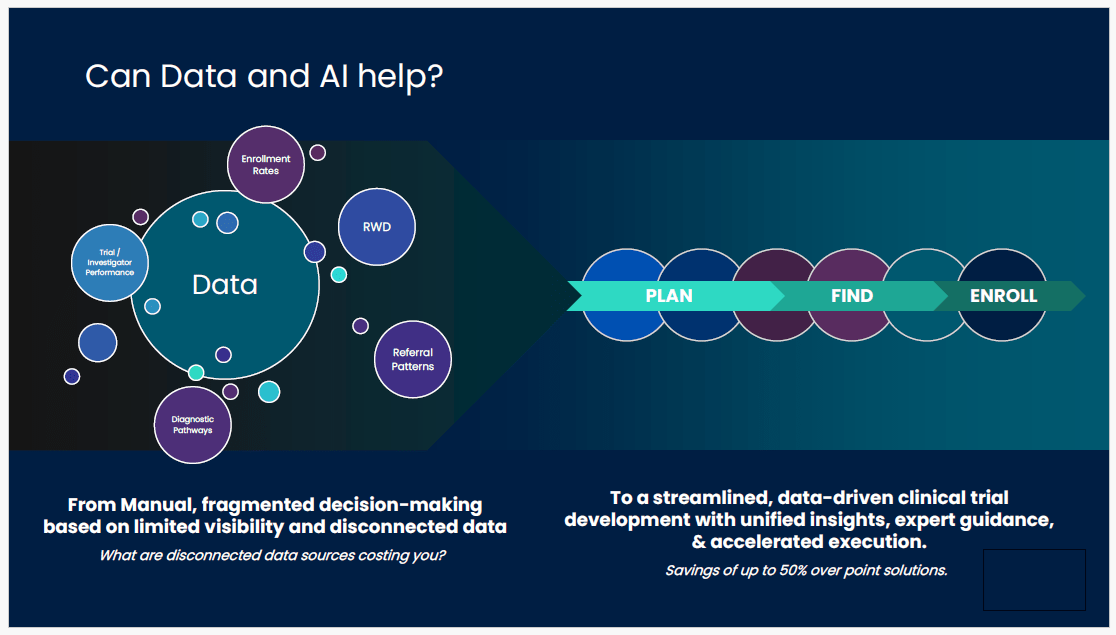
At Citeline, feasibility and patient recruitment/enrollment go hand in hand, as reflected in two of our sessions, “Design with Enrollment in Mind: The Feasibility-Informed Protocol” and “Start with Patients, End with Confidence: Rewiring Feasibility for Real‑World Enrollment.” In the first session, Claire Riches, Citeline VP of Clinical Solutions, echoed the Citeline mantra of “plan, find, enroll,” reiterating the importance of a holistic approach to patient recruitment. Riches was joined by Melissa Harris, Global Head of Patient Recruitment & Engagement at Fortrea, who discussed the inherent problems with so-called unicorn protocols. “A unicorn protocol is really pretty and it sparkles,” she said, but “you can’t recruit for one of those.”.
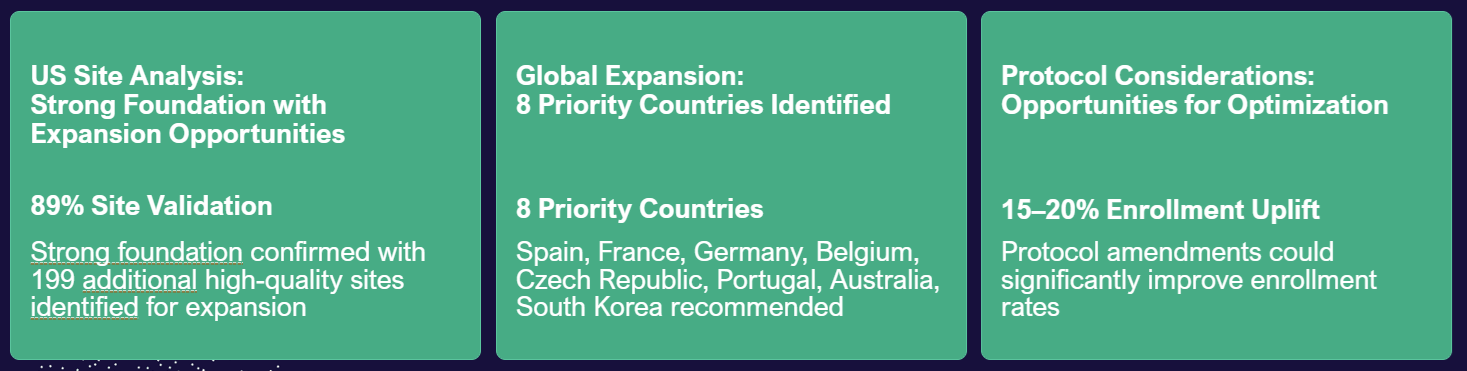
In the second session, Christina Masturzo, SVP, Clinical & Regulatory Product, and Anjani Varma, Senior Product Marketing Manager, shared a case study involving a Phase III cancer study. Using an AI-enabled protocol analysis, Citeline implemented a three-tiered analytical strategy to optimize inclusion/exclusion (I/E) criteria, validate US sites, and prepare for global expansion. In the end, this sponsor gained the data it needed to back up its decisions and the confidence it needed to proceed with the trial.
Recruitment for rare disease trials presents a unique set of challenges. Melody Aldred, Study Director & Community Lead at Novartis, explained the difference between a traditional recruitment funnel and one for rare disease patients. “The funnel,” she said, “assumes that you’re going from a large number of people and it also assumes that they are moving in a systematic, linear way. Rare disease patients are moving in a maze of different clinicians and patient advocacy groups and just peer-to-peer interaction.”
Aldred listed several factors crucial to the recruitment of rare disease patients: how patients are identified/mutations of rare diseases, how outreach is conducted, alliances with patient advocacy groups, and incorporating concierge services.
To learn more about our patient engagement and recruitment solutions, including Citeline PatientMatch for recruiting hard-to-find patients, visit Citeline.com.

Darcy Grabenstein
Director of Content Strategy and Thought Leadership | Citeline
Darcy is the Director of Content Strategy and Thought Leadership for Citeline. A journalist by training, she has more than 30 years of experience in marketing, advertising, and public relations.
What were the main patient recruitment themes at SCOPE Summit 2026?
Patient recruitment discussions at SCOPE Summit 2026 focused on enrollment planning, diversity and retention, and the overall patient experience.
What role does artificial intelligence play in improving patient recruitment?
AI was highlighted as a key enabler of future recruitment transformation. Potential benefits include harmonized data systems, seamless integration across the recruitment journey, improved protocol design, and scalable collaboration between human expertise and machine intelligence.
Why are traditional recruitment funnels failing patients?
Traditional funnels often prioritize volume and speed over patient experience. Slow screening, overly restrictive eligibility criteria, and single-sponsor trial matching can frustrate patients and cause drop-off.




Discover the key challenges shaping rare disease research today — from diagnostic delays to structural barriers — and evidence-based strategies to improve patient identification and trial readiness.

To enable the booking feature, please enable all cookies in your browser.

