AI Digital Twins in Clinical Trials: Beyond Virtual Patients
Article
Clinical

Traditionally, digital twins in clinical trials have simulated how “virtual patients” may respond to therapies leveraging historical and real-world data (RWD). Recently, in some pharma circles, the concept has been broadened to include other aspects of clinical trials, such as the design of study protocols.
The concept of digital twins has been around for a long time. For example, in the 1960s, the US National Aeronautics and Space Administration (NASA) built physical replicates of spacecrafts to simulate space missions. The idea of building digital replicas of clinical entities is not new to pharma, but large language models (LLMs) have expanded existing capabilities. Because LLMs can learn how concepts relate to one another across multimodal data, they can help form a working picture of a real-world system and help us test scenarios under different conditions, says Aleksandra Petkova, Citeline AI Solution Architect.
“Because LLMs can learn how concepts relate to one another across multimodal data, they can help form a working picture of a real-world system and help us test scenarios under different conditions.” — Aleksandra Petkova, AI Solution Architect, Citeline
“A digital twin in clinical trials,” explains Luca Parisi, Director of Data Science, “is a virtual model of a patient, patient population, or another entity in the clinical trial, such as a drug, or the clinical trial itself.” “Digital twins,” he continues, “represent a paradigm shift from designing clinical trials based mainly on precedents to designing them within a truly predictive what-if scenario modeling workflow.”
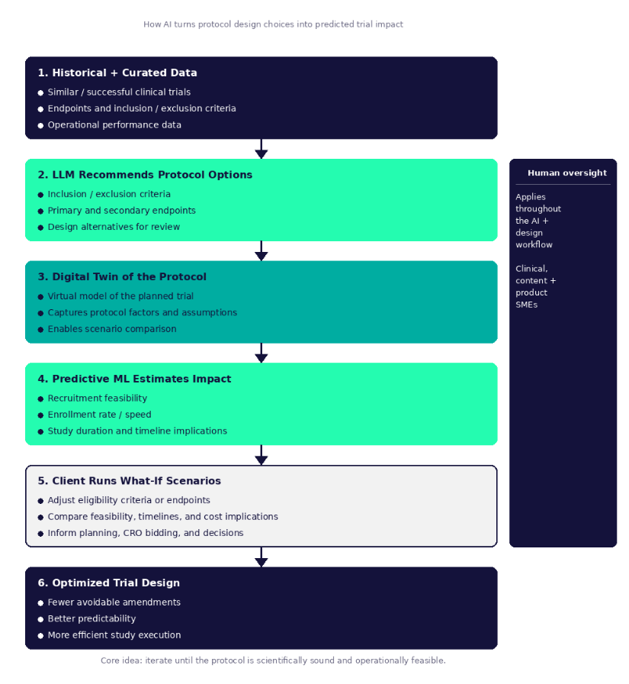
In Citeline’s Protocol SmartDesign solution, Parisi says, the concept extends to a “digital twin” — a simulation modeling, to be more precise — of the protocol, using AI to model its parameters, factors, and their impact on downstream operational trial metrics, enabling sponsors and CROs to simulate and optimize trial designs before execution by:
The end goals are to reduce costly protocol amendments, improve predictability, and optimize study execution, by design.
Drug development continues to grow in complexity, and that complexity is increasingly difficult to model with conventional methods. Using Protocol SmartDesign, Citeline benchmarked Phase III non-small cell lung cancer (NSCLC) trials over the past decade and found that unsuccessful trials enrolled three times more slowly and activated 33% more sites than their successful counterparts. The digital twin approach made it possible to dissect the drivers behind these outcomes, moving beyond static historic benchmarks to simulate specific protocols and generate enrollment-rate forecasts that were 33% more accurate.
| Metric | Finding |
|---|---|
| Enrollment speed | Unsuccessful NSCLC Phase III trials enrolled 3× more slowly than successful counterparts |
| Site activation | Unsuccessful trials activated 33% more sites than successful ones |
| Forecast accuracy | Protocol SmartDesign enrollment-rate forecasts were 33% more accurate than static historic benchmarks |
| Expert alignment | AI recommendations ~90% aligned with clinical content experts on quality/content and format/structure |
| LLM accuracy | Over 20% more accurate than off-the-shelf, state-of-the-art commercially available LLMs |
Unsuccessful Phase III NSCLC trials enrolled 3x more slowly and activated 33% more sites than their successful counterparts. Protocol SmartDesign's digital twin approach generated enrollment-rate forecasts 33% more accurate than static historic benchmarks.
Therefore, “digital twins are helping transform clinical trial design from a static planning exercise into a predictive, iterative, simulation-driven process, enabling sponsors and CROs to pressure-test and optimize protocol decisions and operational impact before the trial even begins,” says Parisi.
The advantage of a digital twin or model, says Lead Data Scientist Bianca De Blasi, is in the clinical planning stages. “It allows sponsors to be proactive,” she offers, “not to wait until the trial is completed to course-correct, but to identify risks and act on them before a patient is ever enrolled.”
Ming-Da Lei, Director of Product Management AI/ML, uses the analogy of an automobile to further explain digital twins of clinical trial protocols. He compares the digital twin modeling of a trial to the model of a car. Just as the control system feeds into the car's plan model and determines how the car will run, the protocol design model feeds into clinical trial plan model, helping sponsors understand and anticipate how the trial will run.
When it comes to AI, Protocol SmartDesign leverages the best tool for each job. It uses LLMs, machine learning (ML), and historical operational clinical trial data. An LLM recommends I/E criteria and endpoints based on similar and historically successful trials. Predictive ML-driven models then estimate their downstream operational trial metrics. These recommendations are grounded in curated historical datasets and supported and validated by human oversight (both content/clinical and product subject matter experts), as being ~90% aligned regarding both quality/content and format/structure with content clinical experts, and over 20% more accurate than off-the-shelf, state-of-the-art commercially available LLMs.
Skye Hodson, VP of Clinical Solutions, says the key to risk reduction is the ability to systematically evaluate the drivers of performance in protocols and model anticipated results across scenarios, designing with greater precision. “In our Citeline platform,” he explains, “we help you dynamically dissect different cohorts of trials and compare them to the traits of operationally successful trials.” Understanding which design characteristics drive different outcomes, he says, lets you forecast enrollment rate and study duration more accurately, shifting from historic benchmarks to forward-facing predictions.
“With advancements in agentic AI,” says Chief Data Scientist Hassan Malik, “I can see the concept of digital twins getting more popular.” He notes that this is an extremely valuable, low-cost tool to make assessments and help with dynamic decision making.
While AI agents are designed to make people more efficient, not replace them altogether, Malik notes that AI agents tend to be more comprehensive and produce very precise, high-quality answers. “They don't miss crucial, operationally relevant details, because they can process more information than humans,” he says.
Agentic AI is here to stay. In fact, there is even a consortium devoted to the use of AI agents in drug development. The AIAgent4Science Consortium brings together leading research institutions, innovative startups, and world-class researchers to advance the application of AI agents in drug discovery and pharmaceutical research.
A closing caution: A digital twin is only ever as good as the data behind it. AI can predict how the real world will behave only if it faithfully re-creates that world and the complex relationships within it, and that faithfulness depends on disciplined ontologies, taxonomies, data curation, mastering, and well-governed knowledge bases. The more entities captured, and the cleaner and better organized the data, the more reliable the twin. When the data foundations are right, the predictions follow; neglect these foundations, and even the most sophisticated AI will only ever mirror the gaps in what it was fed.
What is a digital twin in clinical trials?
A digital twin is a virtual model of a patient, patient population, drug, or clinical trial itself — used to simulate and optimise decisions before execution. Using historical and real-world data combined with AI, digital twins allow sponsors to test scenarios and forecast outcomes without waiting for a trial to complete.
How does AI improve digital twin accuracy in clinical trials?
LLMs learn relationships across multimodal data, enabling more realistic simulation of complex trial dynamics. Predictive ML models then estimate downstream operational metrics such as enrollment speed, site activation rates, and study duration — producing forecasts measurably more accurate than static historical benchmarks.
What is Protocol SmartDesign?
Protocol SmartDesign is Citeline's AI solution that applies digital twin simulation to clinical trial protocol design. It helps sponsors optimise inclusion/exclusion criteria, endpoints, and feasibility parameters before a trial begins — reducing costly protocol amendments and improving predictability.
How accurate is AI-driven protocol design compared to human experts?
Citeline's Protocol SmartDesign recommendations have been validated as approximately 90% aligned with clinical content experts on both quality/content and format/structure, and over 20% more accurate than off-the-shelf, state-of-the-art commercially available LLMs.
What is the biggest risk when using AI digital twins in clinical trials?
The primary risk is data quality. A digital twin is only as reliable as the data it is built on. Predictions depend on disciplined data curation, well-governed knowledge bases, and robust ontologies and taxonomies. Without strong data foundations, even the most sophisticated AI will replicate the gaps in its training data.
How do digital twins relate to AI clinical trial design?
Digital twins are a core enabling technology for AI clinical trial design. By creating a virtual model of the protocol and simulating its operational performance, AI tools like Protocol SmartDesign shift trial design from a static planning exercise to a predictive, iterative process — allowing sponsors to optimise before committing to execution.
Aleksandra Petkova, AI Solution Architect, Citeline
Luca Parisi, Director of Data Science, Citeline
Bianca De Blasi, Lead Data Scientist, Citeline
Ming-Da Lei, Director of Product Management AI/ML, Citeline
Skye Hodson, VP of Clinical Solutions, Citeline
Hassan Malik, Chief Data Scientist, Citeline
Darcy Grabenstein, Director, Content Strategy & Thought Leadership, Citeline
Coming soon: A comprehensive white paper expanding on the themes raised in this article.