Clinical Trial Disclosure Compliance a Moving Target Due to Ever-changing Global Regulations
White paper
Regulatory & Compliance

Maintaining clinical trial disclosure compliance is a challenge, whether a sponsor is conducting five trials or 500 trials. For sponsors with trial sites in multiple countries, keeping up with constantly changing global regulations makes compliance even trickier. Let's take a look at some sobering statistics as well examples of the types of changes sponsors can expect.
Table 1. Top 10 countries/regions with changes/updates Sept. 30, 2022 - May 9, 2023
| Country/Region | Changes | Updates |
|---|---|---|
| EU | 16 | 39 |
| International Registries | 7 | 9 |
| UK | 5 | 10 |
| US | 3 | 12 |
| Japan | 3 | 9 |
| Netherlands | 3 | 4 |
| Ireland | 3 | 3 |
| Italy | 2 | 2 |
| Denmark | 2 | 3 |
| New Zealand | 1 | 2 |
To date this year, 115 updates have been tracked across global regulatory agencies. As a result, these changes necessitated 59 updates to the TrialScope Intelligence database. Additional countries with recent disclosure updates include Australia, Bosnia, Canada, Germany, India, Latvia, Panama, Peru, Serbia, Slovakia, Switzerland, and Thailand.
In the EU, until Regulation 536/2014 (EU CTR), requirements for clinical trial applications varied according to the member states. The EU CTR that replaced the clinical trials directive (EU CTD) in January 2023 required that Member States revise their local legislation to be consistent with the regulation.
The most common types of global disclosure updates are new guidance documents, newsletters — primarily the European Medicines Agency (EMA) since the mandatory implementation of the Clinical Trial Information System (CTIS) portal — and authority news and notifications.
Changes to disclosure regulations are nothing new. In a 2020recap, Thomas Wicks, Head of Transparency Operations for Citeline, outlined five significant developments, including US Federal Drug Administration (FDA) guidance on civil monetary penalties for disclosure noncompliance and Japan requiring disclosure of protocol and trial results information on the jRCT registry. While the coronavirus pandemic and Brexit precipitated many of the changes that year, regulatory agencies continue to finetune their disclosure rules, much to the chagrin of the sponsors trying to keep up with them.
Given existing EMA and Health Canada datasharing requirements, sponsors may need to consider how they will anonymize data collected from devices like mobile phones and wearables. This could lead to more targeted regulations emerging in the future to provide guidance around data capture through these types of consumer technologies.
The processes for implementing disclosure rule changes varies widely. In the UK, for example, the process for updating regulations is consistent with government departments. Smaller changes to regulations can be made by the agency on behalf of the secretary of state. Major updates to policy would need to be made in the form of a Statutory Instrument which is laid in Parliament.
In India, according to Shridhar Narayanan of the India Pharmaceutical Alliance (IPA), an expert committee drafts regulations and guidelines, which are shared with all relevant stakeholders for input. Once the changes are made, they are announced on the Central Drugs Standard Control Organization (CDSCO) website. Official regulatory points of contact from each sponsor organization are also notified via email. Sponsors' regulatory intelligence teams closely liaise with the CDSCO office to understand any recent release of new regulations or regulatory amendments, if any.
Japan has two laws relating to pharmaceuticals: The Pharmaceuticals and Medical Devices Act, which applies to commercial trials that include products intended for marketing (“Chiken” trials); and the Clinical Trials Act, which applies to non-commercial trials, including those funded by manufacturer and unapproved/off-label products.
According to the Ministry of Health, Labour and Welfare (MHLW), registration with the Japan Registry of Clinical Trials (jRCT) is required when conducting a clinical trial in Japan.
Clinical trial disclosure is stipulated in Article 272-2 (in Japanese) of Japan’s Ministerial Ordinance for Enforcement of the Act on Securing Quality, Efficacy and Safety of Pharmaceuticals and Medical Devices, Regenerative and Cellular Therapy Products, Gene Therapy Products, and Cosmetics (PMDAct). While this act dates back to 1961, recent development such as the advent of digital healthcare have prompted further updates.
In January 2018, member companies of the Japan Pharmaceutical Manufacturers Association (JPMA), part of the International Federation of Pharmaceutical Manufacturers & Associations (IFPMA), committed to clinical trial data sharing based on the “IFPMA Principles for Responsible Clinical Trial Data Sharing.”
Under the Clinical Trials Act (CTA) enacted in April 2018, a clinical trial plan must be submitted to the MHLW before the trial's start. It should be noted that the act applies only to interventional studies, and not to prospective or retrospective observational studies. The trial plan must include World Health Organization (WHO) Registry Network specifications, details of participating sites ― such as principal investigator (PI) and site contact information ― along with CRB approval date and facility details. In addition, the trial plan must be uploaded to the Japan Registry of Clinical Trials (jRCT).
jRCT allows for the registration of all types of clinical trials, including drugs, medical devices, and observational studies. Trials can be registered on its platform in both Japanese and English, and should be registered prospectively (i.e., prior to first participant consent). Protocol and results information for Phase I to IV trials is made publicly available. A summary of the trial results is required to be submitted within one year of the clinical trial completion date for specified clinical trials, in compliance with the CTA, or at least within one year after approval or marketing for trials of commercial products.
In March 2023, the jRCT migrated registered data from two registries ― the Japan Medical Association Clinical Trial Registry System (JMACCT-CTR) and the Japan Pharmaceutical Information Center Clinical Trial Information (JapicCTI) ― to the jRCT Clinical Research Submission and Disclosure System.
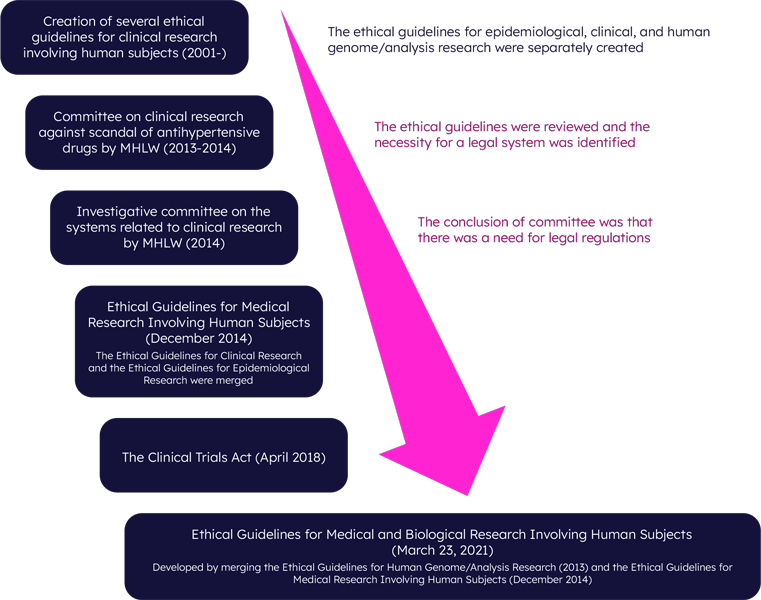
Over the years, Japan has seen several changes in regulations related to clinical trials1:
Source: MHLW: Ministry of Health, Labour and Welfare.
Anthony Keyes is program administrator at Johns Hopkins University, where he, among other duties, directs the ClinicalTrials.gov Program. With all the regulatory changes constantly coming down the pike and principal investigators often managing disclosure compliance, Keyes says, “We call it the Wild West.”
Keyes is co-chair of the Clinical Trials Registration and Results Reporting Taskforce, a national consortium of members of academic medical centers, universities, hospitals, and nonprofit organizations focused on the implementation of domestic clinical trials registration and results reporting requirements in the ClinicalTrials.gov registry. The all-volunteer task force has over 400 member sites, and Keyes says the Multi-Regional Clinical Trials Center (MRCT) of Brigham and Women’s Hospital and Harvard is “the backbone” of the organization.
Stressing the importance of communication, Keyes says, “Every time the federal government comes out with a new policy… we will advertise it through our task force and various organizations.”
While the task force focuses on US-based trials, Keyes says that, as far as the global community is concerned, the Drug Information Association (DIA) Disclosure Community is a reliable source of disclosure regulatory information. The group, led by Francine Lane, Senior Director of Product Management at Citeline, is made up of DIA members who are subject-matter experts and collaborate to determine best practices.
ClinRegs, managed by the National Institutes of Health (NIH), is an online database of countryspecific clinical research regulatory information designed to assist in planning and implementing international clinical research. However, countries are included based on the National Institute of Allergies and Infectious Diseases' (NIAID) international clinical research priorities, which means the scope of coverage is limited. The database features 23 countries, some of which are less strategically important (e.g., Liberia, Mali, Malawi) than those with a preponderance of clinical trial sites. For example, EEA/EU countries and Japan, two areas with important and complex disclosure requirements, are omitted, and details for listed countries are minimal. Recent alerts on social media featured updates for Liberia, Zimbabwe, Bangladesh, Thailand, and Vietnam.
Another NIH resource is the Hot Off the PRS! e-newsletter, which provides timely updates about the Protocol Registration and Results System (PRS), a web-based tool used to submit clinical study information to ClinicalTrials.gov. Individuals can subscribe here. Keyes notes that while a sponsor may have many trial sites outside the US, if the trial itself is based in the US, then the FDA is the governing body.
The EU circulates the Clinical Trials Highlights e-newsletter, providing regular updates on CTIS, the business change initiative Accelerating Clinical Trials in the EU (ACT EU), and related topics. Individuals can subscribe here.
As Keyes emphasizes, study sponsors must hold themselves accountable for disclosure compliance, While many sponsors may rely on contract research organizations (CROs) to handle disclosure, the proverbial buck stops with those in charge of compliance. “We make ourselves the responsible party,” he says.
ClinRegs, the NIH Hot off the PRS!, and regulatory intelligence solutions focused on clinical disclosure such as TrialScope Intelligence, provide true global coverage with continuously updated information about the regulations and registry requirements. For more information on TrialScope Intelligence, a repository of knowledge necessary for global clinical trial disclosure compliance, visit Citeline.com.
1. Maeda H. The Current Status and Future Direction of Clinical Research in Japan From a Regulatory Perspective. Front Med (Lausanne). 2022 Jan 13;8:816921. doi: 10.3389/fmed.2021.816921. PMID: 35096908; PMCID: PMC8792780.




To enable the booking feature, please enable all cookies in your browser.